Posts

Installing MonoDevelop 3 on Ubuntu Oneiric and Mint 12

I really like being able to develop in .NET on linux, and I think that the mono team has come a long way in its efforts to make mono-based applications production-viable.  Sadly, I'm guessing that the majority of mono developers use mac, opensuse, or windows because those are the only platforms that dependably have pre-built binaries and installers.  Since I use Mint (a variant of Ubuntu), I'd really like a simple method for installing a current version of MonoDevelop. Recently, I needed to install Mint on my new laptop and so I payed close attention to how I installed MonoDevelop and turned it into a script -- which you can now use!  I've tested it on a fresh Mint 12, but it should also work on Ubuntu Oneiric. The script: Installs the git client and the dependencies necessary to build MonoDevelop from source. Downloads the source code for MonoDevelop from github. Configures the build script to install the stable profile into /usr/local (/usr/local/monodevel...
Installing CouchDB 1.2 on CentOS 6

Image
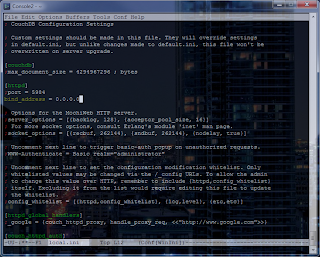
CouchDB has a really great idea behind it.  Whether or not CouchDB delivers on it, I've been wanting to discover for a while.  Only way to do that is kick the tires, so I started the process of figuring out how to install it. First disappointment is discovering a general lack of documentation.  But my first appreciation is how simple it is once you figure out what needs to be done. CouchDB runs on erlang, so you need to install erlang from the EPEL repository.  In order to use that repository on CentOS 6, run the following command: sudo rpm -Uvh http://download.fedoraproject.org/pub/epel/6/i386/epel-release-6-5.noarch.rpm Now you can install erlang: sudo yum install erlang That will bring with it a number of dependencies, such as wxWidgets.  With erlang now available, it's time to download the CouchDB source code from here . As of this writing, the latest release is 1.2.0, although 1.3 is in alpha in master.  I'm electing to use the stable releas...

Invalid provider type specified when accessing X509Certificate2.PrivateKey

Today, I was attempting to digitally sign a byte array with my private key so that I could produce an event on the event bus and a consumer could ensure that the message came from me and was not modified while in transit. public byte[] SignData(byte[] data) {   X509Store certStore = new X509Store(StoreName.My, StoreLocation.CurrentUser);   certStore.Open(OpenFlags.ReadOnly);   // the DN I get is CN=name,CN=Users,DC=example,DC=com   // but the DN on the cert has spaces after each comma   string spacedDN = UserPrincipal.Current.DistinguishedName.Replace(",", ", ");   X509Certificate2 cert = certStore.Certificates     .Find(       X509FindType.FindBySubjectDistinguishedName,       spacedDN,       true)     .OfType<X509Certificate2>()     .FirstOrDefault();   if (null == cert) { ...

Establishing a SSL connection to RabbitMQ using the .NET client

Image
First, I'm making the assumption that you've read, re-read, and followed the SSL tutorial on rabbitmq's website .  If you haven't done everything that it's instructed you to do (including adding your certificates to the Windows Certificate Store using certmgr), none of this code is going to work for you.  If you have, this code should "Just Work™". Here's the complete code file that works for me.  You will (obviously) need to change the names of the servers, and the thumbprint of your certificate. Note that this code only uses your client and server's certificates to establish a secure connection.  You are still logging in as guest.  I will show you how to use your client certificate to authenticate yourself below. using System; using System.Linq; using System.Security.Cryptography.X509Certificates; using System.Text; using RabbitMQ.Client; using RabbitMQ.Util; namespace RabbitSslTest {     class Program     {   ...

Windows does not always honor DNS order

I was having a problem where some internal server names would become unresolvable after being resolvable.  After becoming tired of flushing the dns resolver cache, I finally opened wireshark to see what was going on. To my surprise, windows was using my secondary DNS (8.8.8.8) instead of my primary, internal DNS!  After some searching, I finally found this knowledge base article . This behavior occurs because the Windows XP DNS Client service (Dnscache) follows a certain algorithm when it decides the order in which it uses the DNS servers configured in the TCP/IP properties. If the DNS server list is reprioritized, the Windows XP DNS Client service resets the server priority at periodic intervals. By default, the server priorities are reset every 15 minutes.  Luckily, the workaround in that same article fixes the issues I was having. To work around this behavior, modify the registry so that the DNS server that is configured first is tri...

Getting Started with Ruby on Rails on Ubuntu 11.04

Recently, my friend Richard has been getting into Ruby. At first, I scoffed , telling Richard that Ruby might be a fine language, but I want nothing to do with the people who write in Ruby. Remember back in the day when we all read slashdot ? Pretty much anyone who admitted to running or even just not hating windows would eventually be set on fire in the comments. I imagine those zealots as the same group that evangelizes Ruby. I'm not alone in thinking this. The problem, though, is that I'm starting to notice Ruby creeping into my radar more and more. My investigation of node.js made me realize that a lot of the frameworks I like are actually... ports from Ruby. I think technologies like LESS, SASS, and CoffeeScript are pretty cool. And although they're hardly exclusive to Ruby , that's the general direction they're coming from. It's even hard to read about state-of-the-industry testing practices without coming across rspec and cucumber . Ruby is begin...

The Case for a Short Bus

We’re building an event-driven architecture (EDA) for our client, so it makes sense that a part of our domain model is going to deal with events. The mountain of concerns associated with moving events around in an EDA is most often handled by an enterprise service bus (ESB). How many concerns, you ask? Just take a look at Wikipedia’s list of “core capabilities” – the ones that “most observers accept” as part of an ESB’s responsibility. There’s a lot going on there! This is why I have a lot of respect for traditional ESBs and the developers who make them. Unfortunately, in addition to respect, I also have a lot of trepidation when it comes to choosing, installing, configuring, and using an ESB. A lot of the installation and configuration deals with capabilities that I don’t use and the API for those capabilities distracts me from the main use case: creating and consuming events. I wish that traditional ESBs were more like the Spring stack – a set of capabilities that don’t depend on...